Our First 3 Months of Home Schooling in an RV (Fall 2025)

Nov 5, 2025. Our boys, Logan (now 11) and Landon (now 9), had been attending Ascent Academy for the past two years before we decided to hit the road full-time for a year. Before that, they were in public school. Ascent Academy is an alternative school in Austin, TX, based on the Acton Academy model. It has three studios with a tight-knit community of mixed-age learners. If we mapped it to public school, Logan would be in 5th grade and Landon in 3rd grade.


I’ll admit, it was intimidating at first. Our kids loved their school — their community, friends, and guides so much. They had incredible, flexible spaces for learning and play. They collaborated daily, built character, and came home without homework. They worked hard and truly found joy there.
As parents, we want our kids to thrive, and there was so much about Ascent Academy we wanted to carry with us on the road: immersive, hands-on learning through quests, socratic discussions, writer’s workshops, and studio contracts. I really wanted to replicate as much as I could from what they experienced at Ascent.
There’s no doubt that school life for the boys looks completely DIFFERENT now. Leaving Ascent was probably the hardest lifestyle change for them and for us. Did we make the right choice? Were we really equipped to be their guides? The truth is, I still ask that sometimes. They do appreciate the flexibility roadschooling allows, but it’s definitely been an adjustment.
Every homeschooling family does it differently, so here’s a look at what it’s been like for ours. We’re doing our best and constantly evolving!
Here is How We Homeschool On The Road
Preparing for Homeschool
Before we left, I didn’t have a complete plan. I had a direction on what homeschool would look like and how we would do it. I wanted to take the core concepts from Ascent Academy and bring them “into the wild.” That way, the boys could maintain some continuity.
We kept using the same online programs for math and language arts. We didn’t pack many workbooks given that internet access in 2025 is thankfully pretty reliable, thanks to Starlink and 5G hotspots.

A friend who homeschools all her kids gave our boys a neat starter kit that included essential tools for writing by hand. For quests, instead of multi-week projects, I decided on creating “mini-quests” tied to the places we visit or the day’s activities.
Creating a Schedule
We hit the road on July 14th — just two days after the kids’ last day of school. Our “official” first day of homeschool was August 18th, while staying at Tunnel Mountain Trailer Court in Banff, Alberta.
I created a first-week homeschool schedule with familiar routines and time blocks: SMART goal setting, work cycle, lunch, free time, writer’s workshop, quest, studio maintenance, Socratic discussion, reflection, outdoor play, and music practice.

Our first schedule looked amazing on paper … until we tried to live it. A strict schedule was just too rigid for this season of life. It was exhausting trying to stick to the timeline. It didn’t account for recovery after a six-mile hike at Lake Louise in Banff, random weather changes, waking up to no alarms, or back to back travel days.
Needless to say, after a few weeks, we scrapped the formal schedule and shifted to a rhythm that fits our adventure and travel pace.
Homeschooling in a Tiny Space
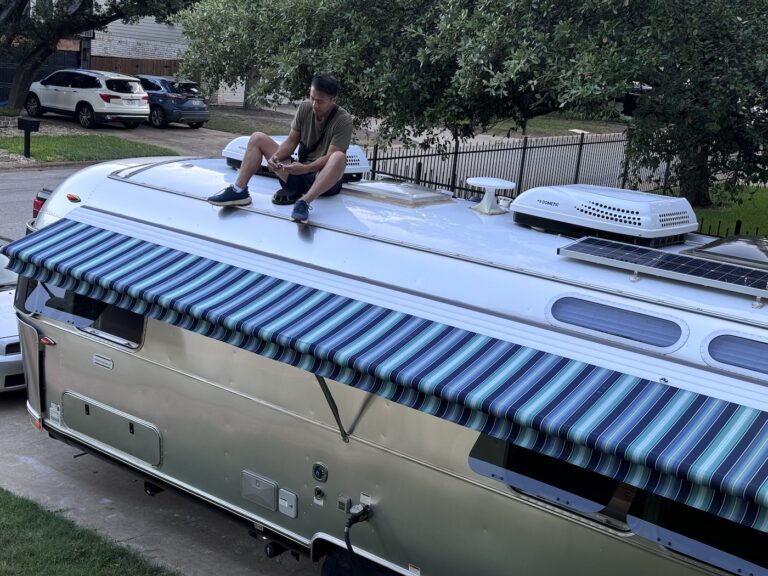
Homeschooling in an RV sounds dreamy — and it is, sometimes. But trying to fit school, computer work, meals, music practice, and play into just 200 square feet takes creativity and a TON of patience. Everyone can hear everything. If one kid’s playing the cello, the other is doing math with headphones on, and someone’s trying to cook lunch, we’re bumping shoulders and butts! It’s a full sensory experience! Having a sense of humor is absolutely critical.
Thankfully, our travels follow good weather, and when the space starts to feel too tight, we just step outside. You’ll often find the boys doing math at the picnic table, reading from a lawn chair, or practicing music outside — usually attracting curious looks (and smiles) from campground neighbors.
Our First Few Weeks of Homeschooling in an RV
Looking back, Ascent prepared us for this more than we realized. The learner-driven, self-paced model fits perfectly with the flexibility we now have. We shoot for on a weekly basis about 12 hours of math and language arts curriculum a week. We also create mini lessons depending on where we’re at or what we’re doing.
Both boys love to read, and we packed a ton of books (plus each has a Kindle). Writing is where we’re most hands-on as parents.
Math
The boys continued using Beast Academy, which they were already familiar with. We love it because it focuses on problem-solving rather than mechanical repetition. Each unit has to be completed with three stars before they can move on, ensuring mastery.

We also tie math to real life whenever possible. For example, while riding the gondola at Whistler Mountain, they calculated its average speed using distance and time.
Avg Speed = Total Distance ÷ Total Time 😉
Reading
Before our trip, the boys loaded up the truck’s rear bench storage with as many of their favorite books as would fit. You’ll find Logan’s beloved Spy School series by Stuart Gibbs in there, and Landon’s well-worn Diary of a Wimpy Kid books.
We love visiting local bookstores and libraries when we stay in one place for a while. The boys also have Kindle Kids editions for digital reading — though they definitely prefer the feel of a real book in their hands.

They choose their own adventure when it comes to independent reading, and we read aloud to them too — usually classics that Thao and I grew up with. Two recent reads: Of Mice and Men and Charlotte’s Web.
Writing
Writing is the most hands-on subject for us. At Ascent, they had Writer’s Workshop — a quest-style writing experience that changed genres each session.
For our first “Writer’s Workshop” on the road, I used ChatGPT to help create a “Camping Adventure Story” framework to teach story structure and writing techniques. A friend also shared a great set of fun writing challenges with bite-sized prompts that connect to real-life lessons.


We’ve added other writing opportunities too — like their adventure memories journal, where they record favorite activities, people they met, and reflections after each location we stay at. They also occasionally write postcards to friends and family, which doubles as writing practice and connection time. We always encourage neat handwriting… though that’s still a work in progress!
Our Favorite Books for Full-Time US Travelers
We love The 50 States: Explore the U.S.A., gifted by fellow wanderlust friends — it’s a go-to family reference for traveling families. We enjoy studying this book together whenever we’re in a particular state. Since visiting National Parks is a big part of our goal, we also picked up 63 Illustrated National Parks at Pinnacles National Park campground store. It’s beautifully done.

National Park Service Junior Ranger Program
One of our favorite ways to make learning fun is through the Junior Ranger Program. At every National Park, the boys grab a Junior Ranger booklet from the visitor center. This makes the experience even more exciting when kids get to learn about the wildlife, geology, history, and cultural heritage of the park when they hike it. The rangers are always so welcoming and eager to help.
They complete activities during hikes, downtime at the campground, or even right at the visitor center. When finished, they return to the ranger desk, interact with the Park Ranger, take the Junior Ranger pledge, and proudly receive their badge and handshake.


In the last 3 months, they’ve earned junior ranger badges from Rocky Mountain, Glacier, Olympic, Redwoods, and Channel Islands National Parks! Unfortunately, due to the government shutdown, they missed their Pinnacles badge — hopefully things will reopen by the time we reach Joshua Tree and Death Valley in December.
Learning Activities Beyond School Work
You’d be amazed by how much of our day-to-day life we can turn into a learning opportunity — history, culture, geography, wildlife, science, and technology are everywhere around us.
At Glacier National Park, they attended a ranger-led program featuring an Indigenous member of the Blackfeet Nation tribe who shared about his tribe’s history and connection to the land. Later that day, we read short stories written by Blackfeet tribe members.

Instead of just reading about or seeing photos of the Golden Gate Bridge, they biked across it! Starting from Fisherman’s Wharf in San Francisco and ending in Sausalito, the ride included several challenging uphill climbs — giving them an eight-mile workout for both mind and body while appreciating the bridge’s incredible engineering and the surrounding beauty.
At the Computer History Museum in San Jose, they spent the day learning how computing evolved. This included the history of hardware, software, the internet, and of course, the latest AI Chatbots. They even saw a working mainframe computer and punch card in action!


In Vancouver, they learned the difference between black bears and grizzlies at Capilano Suspension Bridge — then saw real grizzlies the very next day at Grouse Mountain (and a black bear a week earlier in Whistler!).
While biking Stanley Park, the boys completed a biking adventure worksheet that I created. It included drawing a map of Stanley Park Seawall Loop and identify landmarks, spotting things in nature, and sketching and reflecting on totem poles. I threw in some math problem solving as well — If you bike the first half at 10 km/h and the second half at 14 km/h, what is your average speed for the whole loop? You’ve biked 3/5 of the loop. How many kilometers have you biked so far? You get the idea.


PE
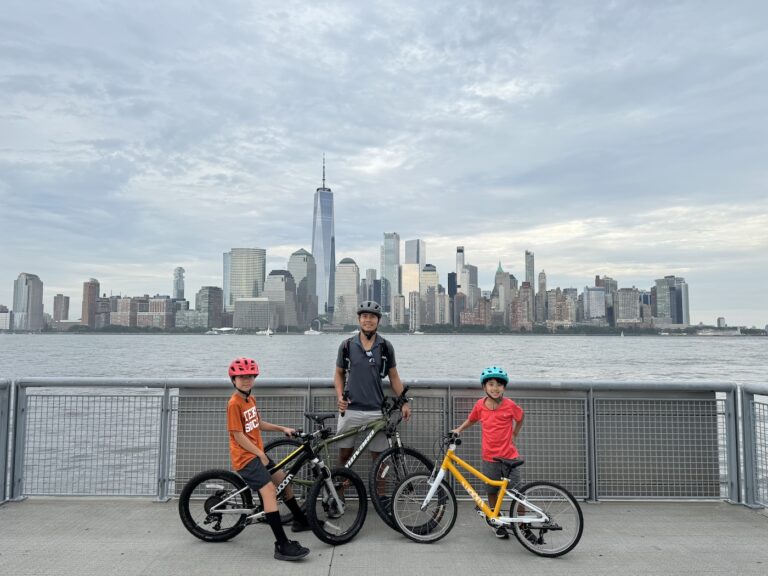
One thing we don’t have to think or plan much is PE. And if you already don’t know, the boys LOVE biking — around the campground, on longer 10-mile rides, or hitting a Downhill MTB park after schoolwork. The boys often roll out of bed, brush their teeth, put on their helmet, and ride their bikes around the campground. If there’s a big field nearby, we’ll break out the wiffle ball or soccer gear for a family game. And of course, anytime we’re out there hiking, we’re surely clocking strenuous steps!


Art
We don’t really do formal “art” as part of homeschooling. However, the boys get plenty of unstructured play. In Cascade Locks, Oregon, we spent hours at the Bonneville Fish Hatchery learning about salmon migration. Later, while camping on the beach in Yachats OR, the boys spent an entire afternoon building a sand city. We didn’t know what they were building at first until they did a grand reveal and walked us thru the fish life cycle — complete with a dam, salmon run, river, and ocean!

Music
Music has been our one consistent activity. We believe that music is such a gift for our kids. It’s been a little over a year now since Logan started flute lessons and Landon started cello lessons in person at Orpheus Academy. Now on the road, every Thursday at 5:15pm CST, the boys log into zoom for their music lessons. Yes it can be annoying when we have to rush back from a 4-mile hike at Mount Rainer to make it in time, but it’s worth it. Music is the ONLY thing we’ve kept as a consistent schedule being on the road so whether we’re going on an adventure or traveling that day, we always work around this!


Landon’s cello is the largest single item we brought along in the RV!
Vietnamese
We’ve made it a “quest” for the boys to strengthen their Vietnamese as we plan to do an extended Vietnam trip. As of this writing they hit their 38 consecutive day streak by completing at least 15-minutes daily. Thao and I have also been more intentional about speaking Vietnamese around them and encouraging the kids to respond in it. Additionally, they chat with grandparents over FaceTime for practice.
Of course, their curiosity has led them to start dabbling in Japanese too — all on their own.
Life Skills
We bought Monopoly: National Parks Edition — and it’s turned into both a fun and educational family activity. They’ve learned about money, negotiation, and risk-taking while playing.
Both boys also have Greenlight debit accounts. Any cash gifts from family or friends get divided into “Save,” “Spend,” and “Share.” Across their travels, they can use their spending account to purchase goods or services. It’s helped them understand money, tradeoffs, budgeting, and delayed gratification.
When Landon’s bike tire blew out in Crested Butte while mountain biking, we turned it into a hands-on “bike maintenance” quest — replacing the tire together at the campground. The next day, they researched different bikes they might want to grow into.


The boys have learned to help set up our RV when arriving at campsites. They have helped be our eyes when backing to the trailer. Landon helps us lower our stabilizing jacks. We can trust the boys to build the campfire. They’ve developed situational awareness when it comes to travel days — Are the RV steps up? Did we connect the 7-way trailer plug for trailer braking?
Things move faster, are safer, and becomes more enjoyable when we collaborate together!
Socialization
We often get asked what socializing is like for the kids. It’s definitely different than before. On the road, friendships come and go more quickly, and there’s a lot more solitude than they were used to. But that solitude has also given us space to grow in confidence and independence as a family.
We always look for other kids at campgrounds so they can play, and we coach them on how to introduce themselves and show genuine interest in others. It’s been harder outside of summer since we don’t run into many full-time RV families, but every connection feels meaningful.

The boys still love chess, a passion sparked by a quest back at school. When Logan got tired of playing against Landon (or me), he made a sign that read, “Can you beat a 6th grader in chess?” Sure enough, a retired RVer named Bob stopped by and played a few rounds. It was such a wholesome moment — two strangers, sixty years apart, connecting over a shared game.

We have also reconnected with friends and family along our route giving the boys a chance to hang with familiar faces. So far, we met up with friends in Littleton, Glenwood Springs, and Telluride Colorado. We recently met with our cousin in San Francisco, another friend who we haven’t seen in a long while in San Jose. Soon we will see friends in Mission Viejo and San Diego!


Thao and I also make an effort to meet neighbors at RV campgrounds and have made several friendships this way and kept in touch.


And of course, the boys have each other. We’re so grateful they get along well — it’s honestly what makes this whole adventure possible. Watching them laugh, play, and work through conflicts together is one of the best parts of this journey. It’s so sweet to see this!
Roadschooling On Travel Days
We typically stay five to six nights in one place, though we’ve had a few shorter stays. On travel days, the boys often do schoolwork while we’re on the move.
With the Starlink Mini mounted on the truck, they can access their online programs easily. They usually aim for 40-minute sessions each of math and language arts, and often throw in extra Duolingo lessons. Reading or Kindle time helps pass the miles too — and they’re still learning as we roll toward the next destination.


Latest Thoughts
I’ll be honest — I’ve felt a lot of pressure since we started homeschooling on the road. Some days, roadschooling feels magical — like when a hike turns into a science lesson. Other days, it feels like we’re just trying to survive. There are days I question if they’re learning enough or if I’m patient enough. There’s always that lingering worry about whether our kids will “fall behind.”
I don’t know if we’ll ever figure it all out — but when I start to feel anxious, I remind myself why we’re doing this. We’re making lifelong memories together. This is an incredible experience that the kids will look back on with appreciation.
Our days are far less structured and more relaxed — and that’s been such a gift. Life at home wasn’t bad by any means, but there’s a new kind of joy and gratitude that comes with this adventure. We’re also learning how to communicate better as a family — you kind of have to when you live in 200 square feet!

We’ve been so encouraged by supportive family, friends, and even strangers who tell us what we’re doing is inspiring. I truly believe the experiences our boys are getting through this journey are invaluable — but even in the hard moments, I see them growing in ways no curriculum could teach!